The following was originally posted on ourworld.katbox.net.
As I am uploading this, it is still less than six hours since I
learned of the death of Robin Williams, who died earlier today of what
the news is saying is an apparent suicide. It's very hard for me to
accept that someone who's life's work was making other people laugh was
so eaten inside that he felt he had to do this. He leaves behind friends
and family and a magnificent body of work and a shaken world that never
thought it would end this way.
I know many
people who suffer from depression, and I suffer from it myself. I also
know that many people who do not suffer from depression conflate it with
ungratefulness - they perceive an inability to be happy as a person's
refusal to be happy. Without knowing the details of his life, I wonder
if this made it harder for Robin - to be so successful in so many ways
and still hurt inside.
If you or someone
you care for has depression, please be kind - to them and to yourself.
Depression is an illness, and people are not made lesser for having
illnesses. I believe that this will be a hard night for many of us, but
if there is a message to be taken from this event, let it be that we
must always let those around us know that they are loved.

Monday, August 11, 2014

Friday, April 4, 2014
The Gradual Joke
I get my weather news from a site called the Weather Underground which, yes, is named after the revolutionary group from the 1960s. On April 1, I noticed that their logo - a cloud floating over a rainbow - was falling down. Back again today, I noticed that stick men had come to clean it up. At this point I took notice of the fact that the logo files are numbered. With that knowledge, I was able to see the entire procession of events. I'm sharing it with you because I think it's clever that this tiny little drama is unfolding at the top of the page each day.
Here's the original logo (well, an archive copy from Wikipedia with the old font):

And here's the unfolding saga, which officially hasn't completed as of this writing:


The logo updates stop there; there is no 16th panel to the story. I assume that by the middle of the month, the logo will be unveiled in its full glory, something I suspect will closely resemble the old Macromedia Shockwave Flash logo that disappeared around 2005 or so. Still, since the logo they're retiring literally goes back to 1997, that's a definite improvement all the same. Good on you, guys.
Here's the original logo (well, an archive copy from Wikipedia with the old font):

And here's the unfolding saga, which officially hasn't completed as of this writing:











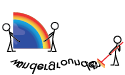



The logo updates stop there; there is no 16th panel to the story. I assume that by the middle of the month, the logo will be unveiled in its full glory, something I suspect will closely resemble the old Macromedia Shockwave Flash logo that disappeared around 2005 or so. Still, since the logo they're retiring literally goes back to 1997, that's a definite improvement all the same. Good on you, guys.
Thursday, April 3, 2014
Get Better
I don't always have to explain something when I present it. Here's a song worth listening to, if you've got a moment:
Wednesday, March 12, 2014
Luigi's Ballad and the Changing, Rubber Face of Pop Culture
First off, have this video, which I highly recommend (if you're not at work). Then, if you want, you can read my thoughts about it.
)
Still here? It's been long since forgotten how weird Super Mario Bros. really is, even by the video game standards of the 1980s. While the pellet-chomping maze prisoner tale of Pac-Man and the ladder-climbing, barrel-jumping experience ofDonkey Kong are both classic and surreal, they (and all other games of the period) share a forced minimalism that mutes the weirdness somewhat. By the middle of the decade, however, processing power had improved enough to allow worlds that could allow for some realism in scenery and character interaction. Nobly, the creators Super Mario Bros. did nothing of the kind. I'd say that they threw everything at the wall and kept what stuck, except that by all appearances everything stuck. How else to explain a game where a plumber and his brother battle turtles and walking fungi to rescue a princess from a an evil turtle lord holding her in an unspecified castle?
The 1980s might also be the decade that pop culture became self-aware for the first time. The watershed example is The Simpsons, of course, but even some earlier works that don't lean on pop culture for satirical purposes were beginning to get in on the act. Back to the Future has a rich undercurrent of cultural references that define both the home world at the start of the movie (California in 1985, home to '80s-tastic protagonist Marty McFly) and the world he travels to (the same town in 1955, home to his teenage parents). A judicious use of pop culture makes the movie more real.
By the time I was watching TV and movies in the 1990s, the ability to reference pop culture had turned into something of an obsession, culminating with the debut of Family Guy in 1999. This was a show that eschewed the integrated pop culture references of The Simpsons in exchange for sight gags and cutaways that allowed the writers to do virtually anything they wanted at virtually any time, a sensibility that has carried that show through good years and bad. When Family Guy was renewed from cancellation, it was a victory for the show's random style, which has since become a definitive characteristic of Internet humor. And that might be why, for all its flashing colors and hectic pacing, the video at the top of this page strikes me as refined.
Arin "Egoraptor" Hansen - lead animator on the video and part of Starbomb, the group that performs the song - is Internet royalty. I first encountered his works in the middle of the last decade at Flash repository Newgrounds, where he had already garnered an impressive reputation for the "Awesome" series. These were videos in which he would deconstruct a video game at a rapid-fire pace. Here's Metal Gear Awesome, which was the first video he published on Newgrounds. This one is also not recommended for work:
)
Let us all pause to remember that 2006 was eight years ago, and that it was a simpler time. All of the Awesome videos are like that, each one a hot mess by design. It's never really clear how much the low art quality in them reflects a style that hasn't yet matured, and how much the rushed look is deliberate.
Egoraptor later became the cohost of a web series called Game Grumps that I quite frankly can't get into. Listening to two guys crack random jokes over video game footage lacked the visceral punch of rewriting and reanimated the games themselves and using that as a springboard into comedy. (Full disclosure: I'm focusing on Egoraptor because I'm familiar with him. He's joined here by Leigh Daniel Avidan and Brian Wecht, the former of whom is also on Game Grumps, and I know virtually nothing about them, or Rachel Bloom, who sings the part of Peach. There's only so much one man can know about the Internet.)
The Super Mario universe has been broadened considerably since Super Mario Bros. came out, but Luigi's Ballad would still mostly make sense to somebody from 1985 who had played the game. Some visual elements - such as enemies from later games and the references to Mario Kart, which first appeared in 1992 - would get lost, but stylistically the games have remained remarkably similar over nearly thirty years. Perhaps the biggest jump for time-traveling viewers would be the characters' personalities.
Mario and Peach have the sort of weird quasi-relationship shared by Barbie and Ken, or Micky and Minnie Mouse: They're always together, and yet their couple status never seems fully confirmed. We don't get a very good look at their personalities until Super Mario 64, the N64's inaugural game and the first one in which either character speaks. They each get only a few lines (Peach's at the beginning, Mario's looped throughout the game whenever he does anything), but they're enough to give us reinforcements on what we already knew: Peach is a nice person with terrible luck and Mario is a go-getter who is unfazed by absolutely anything. Both of these traits are ramped all the way up in Luigi's Ballad: Mario is unable to stay out of anyone's face about his wants and Peach, while untroubled by his incredibly blunt advances, is too polite to actually choose between the brothers.
Luigi, whose appearance in Super Mario Bros. was as a palette-swapped Mario, has similar in-game characteristics that are ramped down in the song for humor value. He's a nice guy who just wants to do stuff with the girl his brother is also hitting on. The exchange between him and Peach at the song's height is actually kind of beautiful, the idea that these are two people who want to try something, even if they don't know what it is. Mario, of course, ruins all this, but you don't save the same girl from the same bad guy for thirty years without getting a little frustrated.
The immaturity of the subject matter in Luigi's Ballad is a clever rouse: The creators had a fantastic sense of understanding and scope on the source material, as well as how to best bend it to suit the Internet's current sense of humor. That the whole thing manifests itself as a barrage of dick jokes is simply par for the course in this day and age.
The 1980s might also be the decade that pop culture became self-aware for the first time. The watershed example is The Simpsons, of course, but even some earlier works that don't lean on pop culture for satirical purposes were beginning to get in on the act. Back to the Future has a rich undercurrent of cultural references that define both the home world at the start of the movie (California in 1985, home to '80s-tastic protagonist Marty McFly) and the world he travels to (the same town in 1955, home to his teenage parents). A judicious use of pop culture makes the movie more real.
By the time I was watching TV and movies in the 1990s, the ability to reference pop culture had turned into something of an obsession, culminating with the debut of Family Guy in 1999. This was a show that eschewed the integrated pop culture references of The Simpsons in exchange for sight gags and cutaways that allowed the writers to do virtually anything they wanted at virtually any time, a sensibility that has carried that show through good years and bad. When Family Guy was renewed from cancellation, it was a victory for the show's random style, which has since become a definitive characteristic of Internet humor. And that might be why, for all its flashing colors and hectic pacing, the video at the top of this page strikes me as refined.
Arin "Egoraptor" Hansen - lead animator on the video and part of Starbomb, the group that performs the song - is Internet royalty. I first encountered his works in the middle of the last decade at Flash repository Newgrounds, where he had already garnered an impressive reputation for the "Awesome" series. These were videos in which he would deconstruct a video game at a rapid-fire pace. Here's Metal Gear Awesome, which was the first video he published on Newgrounds. This one is also not recommended for work:
Egoraptor later became the cohost of a web series called Game Grumps that I quite frankly can't get into. Listening to two guys crack random jokes over video game footage lacked the visceral punch of rewriting and reanimated the games themselves and using that as a springboard into comedy. (Full disclosure: I'm focusing on Egoraptor because I'm familiar with him. He's joined here by Leigh Daniel Avidan and Brian Wecht, the former of whom is also on Game Grumps, and I know virtually nothing about them, or Rachel Bloom, who sings the part of Peach. There's only so much one man can know about the Internet.)
The Super Mario universe has been broadened considerably since Super Mario Bros. came out, but Luigi's Ballad would still mostly make sense to somebody from 1985 who had played the game. Some visual elements - such as enemies from later games and the references to Mario Kart, which first appeared in 1992 - would get lost, but stylistically the games have remained remarkably similar over nearly thirty years. Perhaps the biggest jump for time-traveling viewers would be the characters' personalities.
Mario and Peach have the sort of weird quasi-relationship shared by Barbie and Ken, or Micky and Minnie Mouse: They're always together, and yet their couple status never seems fully confirmed. We don't get a very good look at their personalities until Super Mario 64, the N64's inaugural game and the first one in which either character speaks. They each get only a few lines (Peach's at the beginning, Mario's looped throughout the game whenever he does anything), but they're enough to give us reinforcements on what we already knew: Peach is a nice person with terrible luck and Mario is a go-getter who is unfazed by absolutely anything. Both of these traits are ramped all the way up in Luigi's Ballad: Mario is unable to stay out of anyone's face about his wants and Peach, while untroubled by his incredibly blunt advances, is too polite to actually choose between the brothers.
Luigi, whose appearance in Super Mario Bros. was as a palette-swapped Mario, has similar in-game characteristics that are ramped down in the song for humor value. He's a nice guy who just wants to do stuff with the girl his brother is also hitting on. The exchange between him and Peach at the song's height is actually kind of beautiful, the idea that these are two people who want to try something, even if they don't know what it is. Mario, of course, ruins all this, but you don't save the same girl from the same bad guy for thirty years without getting a little frustrated.
The immaturity of the subject matter in Luigi's Ballad is a clever rouse: The creators had a fantastic sense of understanding and scope on the source material, as well as how to best bend it to suit the Internet's current sense of humor. That the whole thing manifests itself as a barrage of dick jokes is simply par for the course in this day and age.
Monday, February 17, 2014
The moment of truth
We've moved! ourworld.katbox.net
Originally, this news was going to go up on the Our World website, but that went down. Kuurion was subletting space from friends and for some semi-complex reasons, their site is down too. But that's the past, and I'm finally, after so much time, ready to present you with the future.
If you're familiar with furry webcomics, you've probably been to the Katbox at some point. Home to such genre guiding lights as Las Lindas, DMFA, Caribbean Blue and many more, it's also home to Our World as of today. I approached site owner and founder SoulKat back in August of last year and, to my great excitement, he said yes. Everything since then has been work and planning, both on his side and mine, and today the dream became reality.
I am sorry I didn't get a chance to tell everyone this on the old site, so if you're friends with any of our fans and they're still wondering what's up, please tell them. I still don't know if the blog will continue to be a thing or not, either, but I just wanted to leave this message here. We've got a new home now, and we hope you'll join us there.
Sunday, December 29, 2013
Unto 2014
The more you want to be able to do something, the harder it is not to be able to do it. Just now, what I'd like to be able to do more than anything is summarize. I want to be able to understand all the things that have happened to me over the past 12 months. It's hard because I don't want to analyze so many things that went so badly. There's a price to be paid when what you are and what you think you can be are greatly out of alignment. For some people this constitutes ambition, and for some it's delusion, and the only way to know is to try.
I tried giving up my old life to go traveling, and it was a disaster. It was actually even worse when I got back, for reasons I'd still rather not share. But the life I'm living now makes me happier than the one I left behind to get here. It is for that reason that, for the first time since 2010, I really believe next year will be better than this.
I'm so sorry Our World has gone a year without an update, and it's more or less entirely my fault. The good news is that last night Kuurion sent me the finished versions of the first 12 pages of the prologue chapter. They're as good as anything he's ever drawn, and I can't wait until we can show them to you.
To recap, the rewrite covers the parts of the comic that are currently done as color pages. We're redoing that part of the comic, both in story and art, because neither of us were happy with it. The completed rewrite will segue directly into the existing black and white pages.
I don't know if I'll keep up the blog or not. Kuurion hasn't written a post in literally years, so it's just me now, and my enthusiasm for it has waned. I suppose we'll see. As it stands, I have reasons to believe 2014 will be a good year, and there, too, I suppose we'll see. Thanks for reading.
Tuesday, August 20, 2013
Webcomic Review #10: Homestuck, revisited
Have you ever gotten to the end of a really good book or movie and wished there was more to tell? You will never have that feeling with Homestuck.


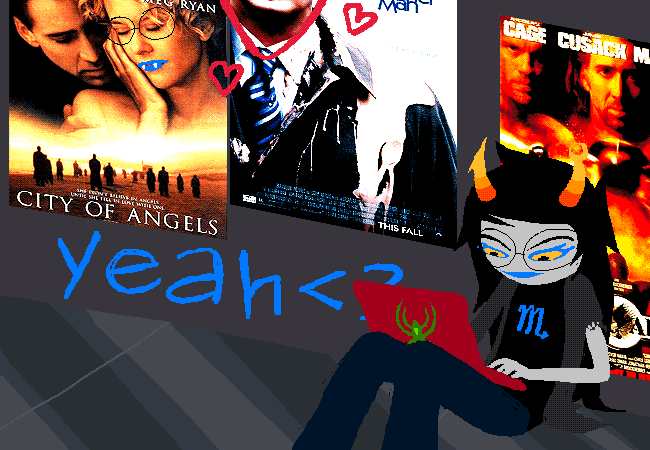
Kuurion introduced me to Homestuck about the same time he wrote our original review for it. That was in June of 2012, and at the time I believed that I would have caught up with the story in about a month. At this point, having read literally thousands of pages and seen dozens of animations, I don't think I'll ever finish it. The story creator Andrew Hussie is telling moves too fast and has too many intricate parts for me to follow anymore. Half the purpose of this review is to apologize to Kuurion and let him know his favorite webcomic has bested me in fair combat.
Homestuck starts with a premise that is deceptively simple. Structured like a text-driven video game, Homestuck introduces you on its first page to an unnamed boy who has just had his thirteenth birthday, and suggests you name him. The reader doesn't actually have any control here, though; when the comic prompts you for something, it's almost like it's talking over your shoulder to someone you can't see. This gets the reader into the habit of ignoring the omnipresent second person structure - though, in appropriately surrealist fashion, it becomes important later. Or at least that's what I think happened.

The comic grows complex quickly, something that caught me off guard because the dialogue is so disarmingly simple. Our protagonist, now named John Egbert, lives a strangely insular life that seems to consist exclusively of talking with his friends Rose, Dave and Jade through an IM client. The story, while nominally a comic pretending to be a video game, is actually conducted largely through huge blocks of IM chat that appear as text beneath the picture part of the comic on most pages. Overshadowing this already complex set of proceedings is the fact that the apocalypse is about to start, and also John has just become the client player in a real-world video game called Sburb.
In fact, each of the four kids is either the server or client to another, allowing them to daisy-chain the control structure. The server player is actually more in control than the client, who appears on their screen - like a video game. What does the client player do? He or she fights imps, which have suddenly appeared and produce useful materials like "build grist" when defeated. The player can use grist and other materials to make things using a trio of confusing machines: the cruxtruder, the totem lathe, and the alchemiter. As the game's second person narration cheekily points out, you'll never have quite enough material to make the thing you want.

If you're not excited by this premise yet, then truthfully I've done something wrong. Homestuck is a masterpiece that will rope you in and hold you for a very, very long time. But it lost me and, try as I might, I can't get the magic back. Hussie shares Stephen King's gift for making the improbable a little too acceptable. The comic starts so far outside the realm of plausibility that it's actually managed to lap the readers by the time they've adjusted their expectations. In addition to the stories of the children, we're introduced to a number of side characters - starting with the Wayward Vagabond, an imp living in a desert in an unspecified time and place.
Once we've wrapped our heads around him, we're introduced to the trolls who are heckling the kids through IM. Except that they are literally trolls, who live on a planet in another universe and created our universe through a game of their own called Sgrub. Then we're introduced to a set of characters called the Midnight Crew in an "Intermission" segment that actually loops around the have direct bearing on the plot. Or maybe those two segments happen the other way around; for the purpose of this review, it doesn't really matter.

There's a pattern that repeats here: the stage keeps getting larger. We get to know the ground rules of the universe through John, and then we meet his three friends. Then we zoom out and meet the Wayward Vagabond, who becomes the first of several "wanderer" characters. Then we zoom out and meet the trolls who made John's universe. Then we go to a second universe, at which point the story breaks into two parallel lines and I gave up. Again, this is literally thousands of pages in, and still with no end in sight.
There are a lot of kind things that can be said about Homestuck, but since they've all already been said, I'd rather give voice to my own, slightly less kind thoughts. While I will openly and honestly say that Homestuck is a rare and significant cultural work, it's also susceptible to diminishing returns. I had loads more fun reading the story at the beginning before it become bogged down under accumulated internal mythology and story lines. There's just too much going on here, and I stopped reading because it stopped being fun to read.
Subscribe to:
Posts (Atom)