Showing posts with label video games. Show all posts
Sunday, March 8, 2015
Civilization V
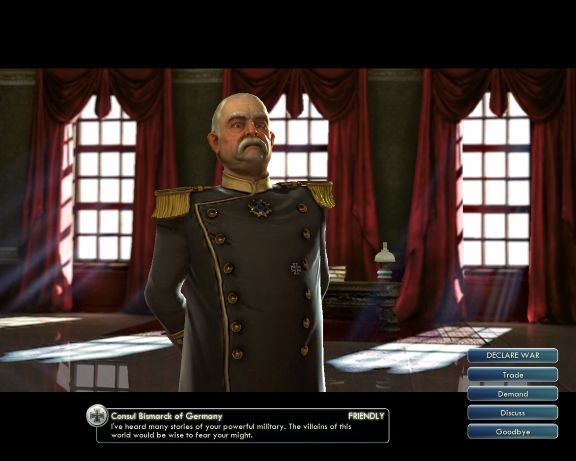
Bismark appears before me, shoulders up, hands behind his back. Lights pours in through the windows in the matte painting backdrop which, confusingly, has some embedded DirectX elements, such as the oil lamp on his desk. He addresses me in German. I can't speak German. Fortunately, there are subtitles.
He wants to know if I am interested in renewing an agreement for open borders. His civilization and mine are on separate continents, and he doesn't get out much because of all the wars he and the Greeks and the Americans have going on amongst themselves, but I always renew the agreement anyway. He gestures with his right hand while continuing to speak a language I don't know, as if to emphasize just how open these borders will be. He is pleased when I accept.
It is 77 B.C. I am Queen Elizabeth I, and half the world answers to my will. All Civilization games are turn-based, with the turns across the eras representing shorter and shorter increments of time. In a normal-speed game a player will blow through the B.C.s in the first hour or so of gameplay, but I've installed a mod that starts the play earlier and slower in a prehistoric age not found in the base game. Because of this I am now researching radio, and will probably have rockets by the time Jesus is born.
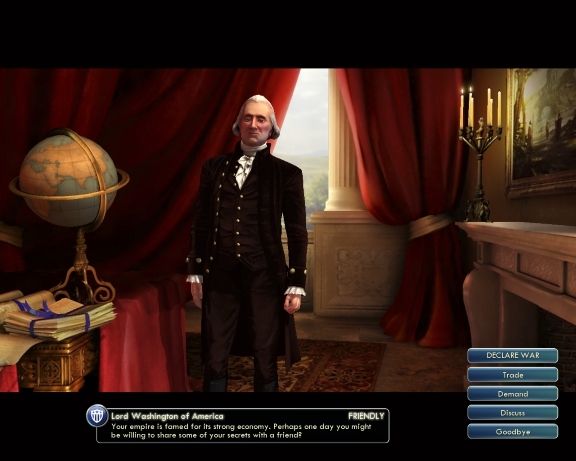
Washington calls up, wondering if I want to do another research agreement. Washington speaks English, which is nice, but the game designers elected to give him a southern accent. This is not unreasonable - he is from Virginia, after all - but it's somehow persistently unsettling. It's probably because he sounds almost exactly like Bill Clinton, except more awkward. We conclude business with an "Alright" on his part, and he makes a small motion with his right hand, as if to indicate a door just off-screen. He has been wearing the same clothes for almost five thousand years.
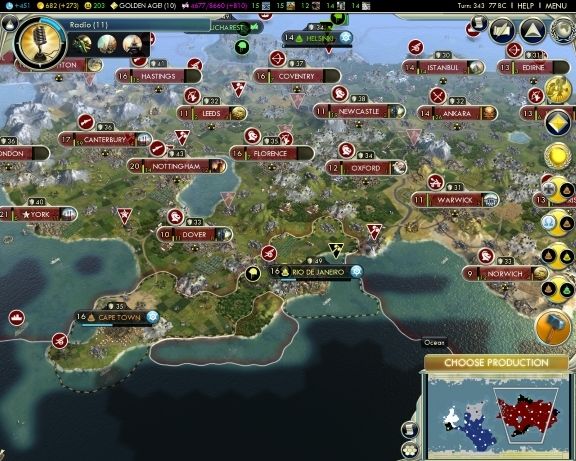
Behold the majesty of the English Empire, so vast it can't all be simultaneously displayed on this ridiculous 5:4 monitor I bought from work.
My civilization began on the shores of the larger of the game's two randomly generated continents. I shared it with two other great powers: the French, led by Napoleon, and the Ottomans, led by Suleiman. Both of them attacked me early in the game, when warfare was decided by the prehistory mod's cave-dwelling combat units. I eventually sued for peace in both wars but never forgot the slight, and went back later with bigger men and sharper sticks. I took control of both fledgling empires so fast that it took me centuries to fill in the gaps between cities on the map.
Time has been good to England. I have drained the vast swamps that once lay inland from London and subdued the last of the remarkably persistent barbarians, who spawn on tiles outside a player's line of sight. A fleet of workers have done such an unnervingly thorough job of improving the terrain tiles that when a new technology reveals a new resource - coal or oil or aluminum - it often pops up beneath an unrelated tile improvement, which must then be torn down to get at the resource.
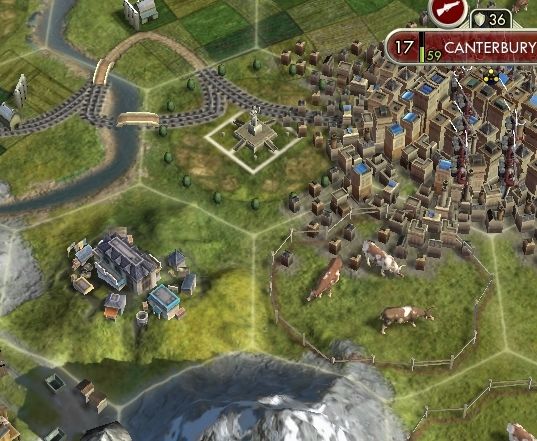
Civilization V uses a hexagonal grid base, unlike the previous four games, which all used squares. This makes the various features superimposed on the grid look a little more natural - the way rivers flow, for instance - but it also makes planning things like road layout or troop movements slightly more counterintuitive. The latter problem is compounded by the fact that most units can no longer stack (as they could in earlier Civ games), and I've had armies tripping over themselves on the way to crush a foe.
There's a spot of oil I can't get at because it's underneath a Landmark. I don't want to destroy the Landmark because they can only be created by Great Artists, a class of Great People who only appear in cities occasionally. Great People are consumed when used to create a tile improvement, and they're also the only units in the game to receive proper names. In this case I think Duke Ellington might have died to make this monument happen, and I don't want to destroy his legacy.
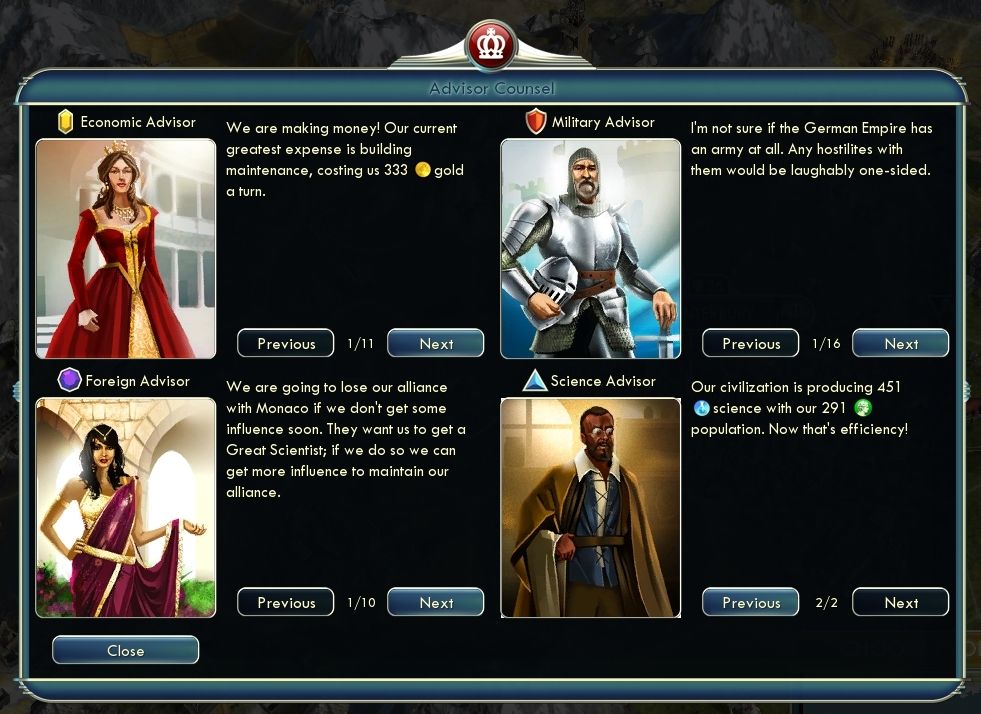
I call up my advisors, who occupy info boxes adjacent to one another, like the Hollywood Squares. The Foreign Advisor, a woman with a Mediterranean complexion and a dress with a fold attached to her left wrist, tells me I need to bolster our alliance with Monaco. Monaco is one of a number of city-states, small powers new to Civilization V. They ally themselves with the greater empires and will go to war alongside them if sufficiently motivated. The British continent holds five such states, of which I am allied with three. Destroying them is an option, but so is paying them to stay on their good side, and picking a fight with somebody that small makes me feel bad. They don't even have visible leaders who pop up when I negotiate with them.
The Military Advisor, who occupies the square one up and to the right of the Foreign Advisor, is a bearded Caucasian man who seems loosely modeled on Ulysses S. Grant. He points out that the Germans don't have much of an army, something I saw firsthand when I sent a unit to explore that continent's interior. Conquering the world is absolutely an option in Civilization V, but I've done so in a recent game and I don't see the entertainment in doing so again so soon. Besides, I feel really bad whenever I crush another civilization and its leader pops up, for the last time, to sadly congratulate me. Napoleon took it well enough, but Suleiman looked positively heartbroken, and I feel terrible about that. Even if he was a jerk to me. Even if it was three thousand years ago.
The Economic Advisor, in the top-right quadrant, informs me that we are making money. She is a Caucasian woman presently dressed like a cross between Scarlett O'Hara and Princess Peach; their outfits all vary depending on what era I'm in. The Economic Advisor's functions are substantially simpler than those of her direct ancestor, the Domestic Advisor from Civilization III, who also handled city happiness and productivity. Those functions still exist, but are now assigned to a menu for each city.
Truthfully, although different social structure options exist, the game is totalitarian and autocratic. The president of the United States - or the queen of England, for that matter - can't really tell a certain town to build a granary, but Stalin could have. If this game is any indication, being Stalin should have been a blast, but there he was, killing half the Soviet Union to make an example to the other half. Some people just don't know how to have fun, and unfortunately a disproportionate number of them become world leaders.
The last of my four advisors, the Science Advisor, a black man with trim spectacles, informs me that York could use a library. As God-Stalin, I - and only I - can make one happen.
With world domination off the table, a few options exist for me to beat the game. I can win the Space Race, which is done by completing the Apollo Project - a National Wonder - and then building the necessary spaceship parts to colonize a new world. This was my preferred way to win in Civilization IV, the Civ game perhaps best remembered as the one where Leonard Nimoy read quotes whenever you unlocked a technology.
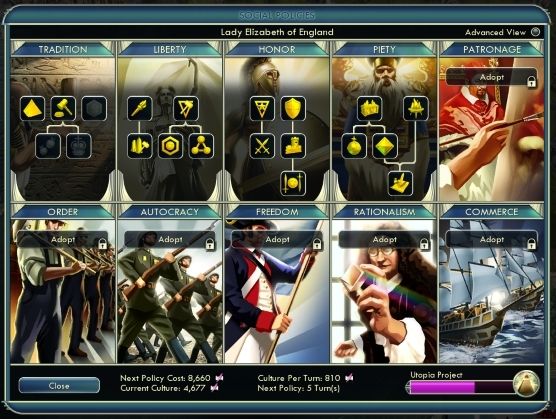
There's also a Cultural Victory. In Civilization V, this means completing five policy branches and then building something called the Utopia Project. I've never done this before, but I'm going for it now. With an entire continent to myself and military worries long allayed, I build cultural building after cultural building across the empire, museums and opera houses and temples. I've snagged a few World Wonders as well. These actually appear on the terrain, albeit in tiny form. The game does a pretty good job integrating them into the grid tiles, but for some reason when I finished Stonehenge it appeared several miles out at sea. I'll have to make sure not to hit it with one of my many, many boats.
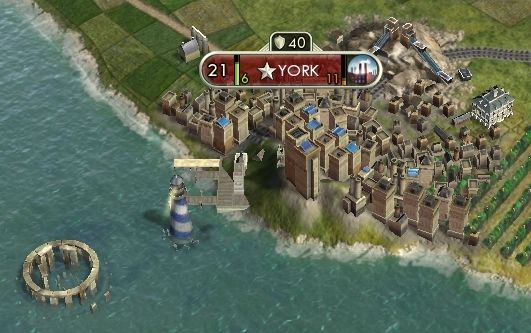
For the hell of it, I pull up the menu for York and then the purchase screen. A library would be 400 gold. The Economic Advisor is correct, though; the empire is rich. I purchase the library and go back to the advisors. The Science Advisor now tells me that a university would be a wise investment. I return to my duties, and wait for Bismark or Washington to call again.
Wednesday, March 12, 2014
Luigi's Ballad and the Changing, Rubber Face of Pop Culture
First off, have this video, which I highly recommend (if you're not at work). Then, if you want, you can read my thoughts about it.
)
Still here? It's been long since forgotten how weird Super Mario Bros. really is, even by the video game standards of the 1980s. While the pellet-chomping maze prisoner tale of Pac-Man and the ladder-climbing, barrel-jumping experience ofDonkey Kong are both classic and surreal, they (and all other games of the period) share a forced minimalism that mutes the weirdness somewhat. By the middle of the decade, however, processing power had improved enough to allow worlds that could allow for some realism in scenery and character interaction. Nobly, the creators Super Mario Bros. did nothing of the kind. I'd say that they threw everything at the wall and kept what stuck, except that by all appearances everything stuck. How else to explain a game where a plumber and his brother battle turtles and walking fungi to rescue a princess from a an evil turtle lord holding her in an unspecified castle?
The 1980s might also be the decade that pop culture became self-aware for the first time. The watershed example is The Simpsons, of course, but even some earlier works that don't lean on pop culture for satirical purposes were beginning to get in on the act. Back to the Future has a rich undercurrent of cultural references that define both the home world at the start of the movie (California in 1985, home to '80s-tastic protagonist Marty McFly) and the world he travels to (the same town in 1955, home to his teenage parents). A judicious use of pop culture makes the movie more real.
By the time I was watching TV and movies in the 1990s, the ability to reference pop culture had turned into something of an obsession, culminating with the debut of Family Guy in 1999. This was a show that eschewed the integrated pop culture references of The Simpsons in exchange for sight gags and cutaways that allowed the writers to do virtually anything they wanted at virtually any time, a sensibility that has carried that show through good years and bad. When Family Guy was renewed from cancellation, it was a victory for the show's random style, which has since become a definitive characteristic of Internet humor. And that might be why, for all its flashing colors and hectic pacing, the video at the top of this page strikes me as refined.
Arin "Egoraptor" Hansen - lead animator on the video and part of Starbomb, the group that performs the song - is Internet royalty. I first encountered his works in the middle of the last decade at Flash repository Newgrounds, where he had already garnered an impressive reputation for the "Awesome" series. These were videos in which he would deconstruct a video game at a rapid-fire pace. Here's Metal Gear Awesome, which was the first video he published on Newgrounds. This one is also not recommended for work:
)
Let us all pause to remember that 2006 was eight years ago, and that it was a simpler time. All of the Awesome videos are like that, each one a hot mess by design. It's never really clear how much the low art quality in them reflects a style that hasn't yet matured, and how much the rushed look is deliberate.
Egoraptor later became the cohost of a web series called Game Grumps that I quite frankly can't get into. Listening to two guys crack random jokes over video game footage lacked the visceral punch of rewriting and reanimated the games themselves and using that as a springboard into comedy. (Full disclosure: I'm focusing on Egoraptor because I'm familiar with him. He's joined here by Leigh Daniel Avidan and Brian Wecht, the former of whom is also on Game Grumps, and I know virtually nothing about them, or Rachel Bloom, who sings the part of Peach. There's only so much one man can know about the Internet.)
The Super Mario universe has been broadened considerably since Super Mario Bros. came out, but Luigi's Ballad would still mostly make sense to somebody from 1985 who had played the game. Some visual elements - such as enemies from later games and the references to Mario Kart, which first appeared in 1992 - would get lost, but stylistically the games have remained remarkably similar over nearly thirty years. Perhaps the biggest jump for time-traveling viewers would be the characters' personalities.
Mario and Peach have the sort of weird quasi-relationship shared by Barbie and Ken, or Micky and Minnie Mouse: They're always together, and yet their couple status never seems fully confirmed. We don't get a very good look at their personalities until Super Mario 64, the N64's inaugural game and the first one in which either character speaks. They each get only a few lines (Peach's at the beginning, Mario's looped throughout the game whenever he does anything), but they're enough to give us reinforcements on what we already knew: Peach is a nice person with terrible luck and Mario is a go-getter who is unfazed by absolutely anything. Both of these traits are ramped all the way up in Luigi's Ballad: Mario is unable to stay out of anyone's face about his wants and Peach, while untroubled by his incredibly blunt advances, is too polite to actually choose between the brothers.
Luigi, whose appearance in Super Mario Bros. was as a palette-swapped Mario, has similar in-game characteristics that are ramped down in the song for humor value. He's a nice guy who just wants to do stuff with the girl his brother is also hitting on. The exchange between him and Peach at the song's height is actually kind of beautiful, the idea that these are two people who want to try something, even if they don't know what it is. Mario, of course, ruins all this, but you don't save the same girl from the same bad guy for thirty years without getting a little frustrated.
The immaturity of the subject matter in Luigi's Ballad is a clever rouse: The creators had a fantastic sense of understanding and scope on the source material, as well as how to best bend it to suit the Internet's current sense of humor. That the whole thing manifests itself as a barrage of dick jokes is simply par for the course in this day and age.
The 1980s might also be the decade that pop culture became self-aware for the first time. The watershed example is The Simpsons, of course, but even some earlier works that don't lean on pop culture for satirical purposes were beginning to get in on the act. Back to the Future has a rich undercurrent of cultural references that define both the home world at the start of the movie (California in 1985, home to '80s-tastic protagonist Marty McFly) and the world he travels to (the same town in 1955, home to his teenage parents). A judicious use of pop culture makes the movie more real.
By the time I was watching TV and movies in the 1990s, the ability to reference pop culture had turned into something of an obsession, culminating with the debut of Family Guy in 1999. This was a show that eschewed the integrated pop culture references of The Simpsons in exchange for sight gags and cutaways that allowed the writers to do virtually anything they wanted at virtually any time, a sensibility that has carried that show through good years and bad. When Family Guy was renewed from cancellation, it was a victory for the show's random style, which has since become a definitive characteristic of Internet humor. And that might be why, for all its flashing colors and hectic pacing, the video at the top of this page strikes me as refined.
Arin "Egoraptor" Hansen - lead animator on the video and part of Starbomb, the group that performs the song - is Internet royalty. I first encountered his works in the middle of the last decade at Flash repository Newgrounds, where he had already garnered an impressive reputation for the "Awesome" series. These were videos in which he would deconstruct a video game at a rapid-fire pace. Here's Metal Gear Awesome, which was the first video he published on Newgrounds. This one is also not recommended for work:
Egoraptor later became the cohost of a web series called Game Grumps that I quite frankly can't get into. Listening to two guys crack random jokes over video game footage lacked the visceral punch of rewriting and reanimated the games themselves and using that as a springboard into comedy. (Full disclosure: I'm focusing on Egoraptor because I'm familiar with him. He's joined here by Leigh Daniel Avidan and Brian Wecht, the former of whom is also on Game Grumps, and I know virtually nothing about them, or Rachel Bloom, who sings the part of Peach. There's only so much one man can know about the Internet.)
The Super Mario universe has been broadened considerably since Super Mario Bros. came out, but Luigi's Ballad would still mostly make sense to somebody from 1985 who had played the game. Some visual elements - such as enemies from later games and the references to Mario Kart, which first appeared in 1992 - would get lost, but stylistically the games have remained remarkably similar over nearly thirty years. Perhaps the biggest jump for time-traveling viewers would be the characters' personalities.
Mario and Peach have the sort of weird quasi-relationship shared by Barbie and Ken, or Micky and Minnie Mouse: They're always together, and yet their couple status never seems fully confirmed. We don't get a very good look at their personalities until Super Mario 64, the N64's inaugural game and the first one in which either character speaks. They each get only a few lines (Peach's at the beginning, Mario's looped throughout the game whenever he does anything), but they're enough to give us reinforcements on what we already knew: Peach is a nice person with terrible luck and Mario is a go-getter who is unfazed by absolutely anything. Both of these traits are ramped all the way up in Luigi's Ballad: Mario is unable to stay out of anyone's face about his wants and Peach, while untroubled by his incredibly blunt advances, is too polite to actually choose between the brothers.
Luigi, whose appearance in Super Mario Bros. was as a palette-swapped Mario, has similar in-game characteristics that are ramped down in the song for humor value. He's a nice guy who just wants to do stuff with the girl his brother is also hitting on. The exchange between him and Peach at the song's height is actually kind of beautiful, the idea that these are two people who want to try something, even if they don't know what it is. Mario, of course, ruins all this, but you don't save the same girl from the same bad guy for thirty years without getting a little frustrated.
The immaturity of the subject matter in Luigi's Ballad is a clever rouse: The creators had a fantastic sense of understanding and scope on the source material, as well as how to best bend it to suit the Internet's current sense of humor. That the whole thing manifests itself as a barrage of dick jokes is simply par for the course in this day and age.
Subscribe to:
Posts (Atom)