Sunday, April 8, 2012

Thoughts for Your Pennies

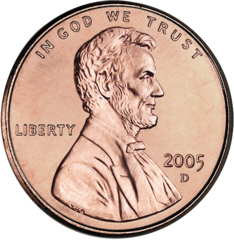
On March 29, 2012, the Royal Canadian Mint announced that it would discontinue the country's penny. In part, it reads "'The Mint will continue to develop new strategies and technologies to meet current national and world market demands,' said Ian E. Bennett, President and CEO of the Royal Canadian Mint. 'The Mint's Winnipeg facility has produced coins for over 75 countries in the past 35 years; therefore we have a solid reputation on which to build a future without the penny.'" That's sort of a ridiculous basis for reassurance - in effect, "We've given you useful things for a long time, so you won't mind if we take one of those things away" - but Canada is moving forward into a penniless future. Will the United States follow?

The last generation of Canadian pennies is being struck out of copper-plated steel. The American penny is made of a similar structure, copper-plated zinc. In both cases, the corrosion-resistant copper is used to shield a less durable metal from the dangers of the outside world. The problem is that it now costs both the Canadian and American governments more than a cent to make a cent. According to the report cited above, the Canadian government pulled the plug when it cost 1.6¢. However, the US mint is grimly plugging along when it costs 1.92¢ (as of 2010). They're also losing money on the nickel (9.22¢ to make), something the Canadian government proudly boasts is not a problem.

The US mint is looking at again reformulating the penny, which was 95% copper until 1982, when it switched to copper-plated zinc. Meanwhile, there are people hoarding the old pennies, waiting for the day they can legally melt them down for the copper content.

Zinc is a light white metal usually used in galvanized steel, bulk castings and roofing. Both zinc and steel are used as fillers in pennies because there's more than a penny's worth of copper in a copper penny. While zinc is used to protect steel as a sacrificial coating (think the short-lived shininess of new guardrails on the interstate), it is not particularly durable in and of itself, and will develop a crusty white coating of zinc oxide. For that reason, pure zinc wouldn't work for a coin that's handled regularly. Nor would pure steel or regular iron. That leaves only one metal cheap enough: Aluminum.

That's what an aluminum penny would look like. A test series was struck in 1973 when copper became too expensive. If the US Mint hangs onto the penny much longer, it will probably have to resort to something like this again, although it's hard to say. The problem with the nickel might be a bit easier to solve; the nickel could just be made from zinc and nickel plated.

For now, it's all talk. But sooner or later, something is going to have to give. The Canadian method, interestingly enough, is to leave the pennies as legal tender and let people decide what to do for themselves.

Saturday, March 31, 2012

The Most Fascinating Bad Movie Ever Made

Parody is hard to do right, a fact complicated by the fact that it's often quite hard to tell when people in the genre are trying and when they aren't. For every "Airplane!" there are five "Scary Movies"; for every good Mel Brooks film there are three bad Mel Brooks films. Parody is hard to make appear intelligent and virtually never ages well. And that brings us to the morbid curiosity piece that is "Not Another Teen Movie."

First off, let's look at that movie poster. Click on it; it gets bigger. Movie titles started becoming logos sometime in the late 1970s or so, and in the time since there has never been one that looked less finished than this. The gradated colors of the block letters and the bad shadowing effects point to somebody taking skills learned in Microsoft Excel and transferring them to Corel PhotoPaint. Even if this was 2001/2002 (and it is; note the top billing for the VHS format), that's pretty bad.

The movie itself is a whole other can of twisted aircraft wreckage you pulled out of a swamp. See, although the bulk of what we think of as teen movies came out in the 1980s, the single most definitive entry ever made into the genre - "American Pie" - had come only two years before, although you can see the full list of references here. The amount of material in that list suggests that somebody with a misspent adulthood watched all of these movies, noted things worthy of parody and then built a script around them. The plot line follows this.

Leading lady Chyler Leigh plays Janey Briggs, which was basically the beginning and end of her in movies. Janey is the "pretty-ugly girl," who simply needs to take off her glasses and let down her ponytail to become gorgeous. Her father is crazed alcoholic Vietnam vet Randy Quaid, whose bizarre acting talents were never better used. Janey and her horny younger brother Mitch (Cody McMains) attend a school populated entirely by teen-movie stereotypes. Popular kid Jake (Chris Evans) accepts a bet by other popular kid Austin (Eric Christian Olsen) that he can make any girl prom queen. Janey is chosen.

Other plotlines swirl beneath the surface. Jake's insane pervert sister Amanda (Lacey Chabert) is trying to get him to sleep with her, and later makes out with the elderly undercover reporter who is somehow passing as a teen. Janey's brother and his friends are the stereotypical sex-crazed teens who pack for a crazy trip (that never leaves the neighborhood). Randy Quaid is still Randy Quaid.

Remember how I mentioned earlier that this was 2001/2002? The movie came out in December 2001, which means the home video release (on VHS, you guys!) would have been in 2002. But that also means that this is one of the small crop of films that were made before September 11, 2001 but released after it. Despite all the very real problems with Not Another Teen Movie, it can probably get a better reception now than when it came back. Goofy in a quintessentially American way, this couldn't have played particularly well to people who were sitting in theatres trying to remember what it meant to be American. Having adjusted over the ensuing decade, viewers can now appreciate the lack of quality with clear eyes.

What's really fascinating is that the people who made this film wanted - really, really wanted - for it to work. Ron Lester, the guy who played Reggie Ray, said on the DVD featurette (because there was a DVD featurette, and, God help me, I watched it) that he wanted to be the guy who played a parody of his own role as Billy Bob in "Varsity Blues." He's happy about it (something I suppose I would have never known if I'd bought the VHS copy).

This man's IMDb page shows that at the time, he had been in three feature movies and one of them was "Good Burger." But he wanted to make fun of himself. To continue focus on his character, there is a slot on the scoreboard in the school stadium that shows how many concussions Reggie Ray has left, and it grimly counts down as the movie goes on. There's nothing funny in that when you hear it explained, but seeing it happen you feel a sense of distant and morbid humor, and that humor is the life-giving ichor that stops this film from being totally unwatchable.

Grim one-upsmanship carries the movie like a robot carries an unconscious blonde in '50s horror - stoically, without emotion or the ability to register nuance. Remember the "Czechoslovakian" exchange student in "American Pie," who ends up being an unwitting accomplice in internet sex hijinks? Here they just have an exchange student named Areola, who is naked. All the time. Cerina Vincent, who played her, didn't sound anywhere near as happy as Ron Lester in the featurette. I believe she was entirely edited out of the film when it ran on television, which hopefully helped keep the people who had seen her here and the people who knew her as "the yellow Power Ranger" in separate camps.

I made fun of Mel Brooks at the beginning of this article because I recently rewatched "Robin Hood: Men in Tights," which was clearly made by a comedian at the bottom of his game. But how did that happen? He's a legend; he made "The Producers," "Young Frankenstein" and "Blazing Saddles." How did he sink to making a bad Robin Hood parody followed by an even worse Dracula parody? That last was starring Leslie Nielsen, who rose to maturity in serious roles before taking a permanent turn to comedy with - wait for it - "Airplane!" Why does comedy always seem to strangle those who love it most?

Wednesday, March 21, 2012

Webcomic Wednesday (Mini) #6: A Softer World

Type: Photographic, three-panel, acontextual art experiment
By: Emily Horne (photographer) and Joey Comeau (writer)
Self-described as: "A Softer World is a comic that was created by Emily Horne and Joey Comeau so that people would recognize them as important artistic geniuses."
Website: http://www.asofterworld.com/index.php
Sample:

If there is one thing that can be said of A Softer World, it is that it never fails to deliver. The series is so totally weird, so completely bewildering that I have yet to understand it - which is really something, after 700 strips made by just two people. One would feel that eventually some sort of pattern would emerge, but at the most I have only managed to pick up sub-currents of dreamlike emotion. It is at times comic, at times tragic; it is polemic a good part of the time, but not always. Sometimes it is perhaps just a little disturbing, and yet it is often reaffirming of the things we would all like to believe are true - in a softer world.

It's hard to attribute credit. Comeau, as the writer, is the driving force - and yet you can't simply stick his thoughts on any old image. They're so off the wall that they can only be paired with something equally abstract yet evocative, and Horne and he are both on the same distant wavelength, one on which I can receive but not transmit.

Oh, to be artistic and Canadian again.

Tuesday, March 6, 2012

Webcomic Wednesday #5: Bastard Who

Alright. This is going to get a bit meta for a moment, so bear with me.

I started writing movie reviews for the local newspaper in 2004, something I still do today. In addition to that, I also also did movie, book and food reviews for the college paper I wrote for in, uh, college. So when Kuurion started throwing the word "blog" around and talking about Webcomic Wednesdays, I was pretty experienced. But there have been stumbling blocks.

See, there's the problem of self-sorting. The theatre here in town has only one screen, and so there's only one movie at a time, so I have to watch what they're showing. Online, it's different: The only webcomics I follow are the ones I think are worth reading, nobody has the time to read all of them, so... self sorting. But now that we're doing the link exchange thing through Ink Outbreak (see the box below the skyscraper ad on the right of Our World) I have all manner of comics thrown at me, and one of them caught my eye. And, contrary to self-sorting for only the stuff I love unequivocally, I found a comic that was (to my eyes) both deeply flawed yet still somewhat engaging. Introducing: Bastard Who.

The thing that needs to be aired immediately for those who didn't pick up on it is that Bastard Who is a bewildering take on Doctor Who, a long-running BBC program that has also attained a cult following here in the US and Canada. I will now give one paragraph synopses of both serials, starting with the show.

Doctor Who is a broad-ranging story of a man who travels in time and space. He is the Doctor, the last of a humanoid race of aliens called the Time Lords, and he travels the universe in a device called the TARDIS, which is disguised as a British police phone box. The other Time Lords were all lost in the Time War, which they fought against the Daleks, raging throughout time and space. Now, the Doctor is a wanderer.

Bastard Who is a broad-ranging story of a man who travels in time and space. He is the bastard, the last of a humanoid race of aliens called the Clock Lords, and he travels the universe in a device called the SARTIV, which is disguised as a refrigerator. The other Clock Lords were all lost in the Clock War, which they fought against the Doll-Ex, raging throughout time and space. Now, the Bastard is a wanderer.

As a big fan of Mad Magazine, I'm quite familiar with the idea of taking a TV show and turning it into a comic in which the characters all have mocking names and the plot is vivisected. But that's not what's happening here - there's far too little humor for this to be considered a comedy.

While there have been eleven Doctors over the run of the TV show - he regenerates instead of dying and gets a new actor and a new personality each time - the Bastard is far less cultured than the three versions of the Doctor who have been on the show since it returned to the air in 2005. I'm not familiar with the older Doctors from the 1963-1989 run, but I'll give the Bastard the benefit of the doubt and assume he's his own man and not specifically derivative of any one Doctor. His good characteristics are matched evenly with shortcomings - a cross between a general idea of the Doctor and maybe a homeless version of Captain Kirk. A little bit spacey, a little bit scuzzy.

It's time to wrap this up, because the temptation to do a point-by-point comparison could drag this on forever. The "New Readers" page introduces the characters well enough, but never mentions Doctor Who. On the other hand, there is a filler image mixed into the run showing the current Doctor standing next to the TARDIS, with the comment that "We’re all Doctor Who fans here anyways, right?" So it's not like author James Riot is trying to pull a fast one on the readers.

The website is a subset of Old Dying Kitty Comics, founded by Riot. Unfortunately, I couldn't find any explanation of what the purpose of, and inspiration for, Bastard Who is. I really wish I knew, because I've reached the end of where I feel comfortable guessing.

The biggest thing that held me on to this was, in fact, that question. The storyline itself never had enough lift, and more than the lightest sprinkling of humor would have been a nice addition to what may or may not have been a parody. Personal verdict: I gave up.

Wednesday, February 29, 2012

Wednesday Webcomic Review 4: Shadowbinders

So a couple weeks ago I attended an online comics convention called WebReef. Not a big event or nothing, but it was a good chance to get some networking, socializing with other comic artists and enthusiasts. It was hosted by the creators of the comic Shadowbinders, (Kambrea and Kneon, unaware of real names) and alongside the other comics I found that weekend I figured I’d give theirs a readthrough as well. And since it’s been a few weeks since our last review was posted, I figured I’d write a review for it as well.


Unfortunately, I have to be honest: I didn’t like what I saw.


The comic starts off pretty good. An action sequence, some interesting-looking characters on a flying ship and a battle. The sequence is brought to an end by a man in red shooting fire from his hands – the man has piercing blue eyes. A mug shot of this man’s face was the host’s avatar at Webreef, and it was those eyes that got me interested in the first place, it was an excellent first impression on a character. There’s no text through the opening sequence of 8 pages, and it’s revealed to be a dream. We enter the life of a teenage girl.

The art is vibrant, full color, and I cant say anything bad about it. My socks weren’t blown off, but I can tell a good amount of effort goes into these pages, and I have respect for that. But it’s the writing that started to turn me off. We go into Mia’s world at school, her crush on the best-looking boy in school and his girlfriend being unbelievably cruel to her (honestly, I don’t think I ever met a bigger bitch in my own high school, and I was the school-wide target for 3 years). Typical high school girl. It’s not for a little while yet that we get back to the ship, which … is another dimension, or something. It’s not made clear, perhaps that’s part of the mystery. But I’m going to stop myself here from simply recapping the story, because that’s not what a review is supposed to do.


The real cast of Shadowbinders is in the extra-dimensional world. Mia’s friends in the real world seem to lack depth, making it difficult for me even able to remember their names. Unfortunately, the same thing happens in the extra-dimensional world. Of the 4 inhabitants of the flying ship that Mia finds herself stuck on, one is a back-talking rabbit-thing who only ever succeeded in slightly disturbing me, one was a woman whose name escapes me (the cast page tells me it's Elaina, and that's not ringing any bells for me) and who seems to serve absolutely no purpose on the ship at all. Tristan is an engineer of sorts who seems to be the right-hand man, and the ship’s Captain, Rhen, is the piercing blue-eyed man… whose first impression breaks down as soon as he opens his mouth.


Rhen is revealed to be a womanizing scoundrel of sorts. He is the most powerful mage in this world, which I suppose gives him some leeway for being overconfident, however he seems to be unable to keep both his eyebrows on the same level and consistently sports a wide, toothy grin. This is referred to as the “Smarm Brow” and my opinion on it was solidified once I’d seen a Lackadaisy page tackle it. Basically, I can’t take a character like this seriously. He lacks the charm that regularly comes with the womanizing scoundrel, as seen in memorable characters like James Bond and Han Solo. I just can’t like him, and that’s a shame, as he is one of the leading characters.


As for the events in the comic, the one thing about it that stood out to me is that everything seems to be just a little bit rushed. The amount of stuff that has happened in 150 pages (half-pages, actually, by the comic’s format) is a little offputting and nothing seems to organically move from one place to another. Logistically it works fine, but nothing had the time to really sink in, it was just off to the next location or story point. Things begin and end rather abruptly and none of the characters have reacted to something in a way that makes me identify with them. Rhen seemed to take an immediate interest and recognize the ring that Mia uses to travel between worlds, which got my attention, but focus was then taken off of that point and hasn’t been brought up again yet.


All in all, nothing about Shadowbinders stood out to me as original, unique, or risqué enough to become really memorable. I would love to see some moments of long-form introspection or one-on-one conversation between the characters that doesn’t revolve entirely around Mia or her dreams – stuff that lets us see into the characters’ inner lives, their personalities. Something to paint the rest of their actions with, and to identify with, because at the moment the only things I can bring to mind is that Rhen is overconfident and cocky, and Mia is … typical. The others haven’t even shown themselves to be that much. I feel like there’s too much focus on the events themselves, and not enough focus on how the characters react to and are affected by them. Like we’re being strung along through plot points and the people exist only as a vessel to carry us from place to place.


But, that’s just my opinion. With 2,300 likes on facebook at 150 pages (Our World has 60 and our facbeook likes never went above 10, half of which are my own real-world friends who don’t even read comics) they must be doing something right. Kneon is also capable of writing some damn good articles, if his investigation of TopWebcomics rankings is any indication (which can, and should be, read here: http://shadowbinders.com/2012/02/09/topwebcomics-com-the-elephant-in-the-room/) but as for his comic itself, I can’t say it caught me.

Monday, February 27, 2012

Once Upon a Time on the Internet

I follow three websites. There are plenty of websites I read for one reason or another - webcomics, news, video, video games - but there are only three websites I actually follow in the sense that the website itself is such an immersive experience that it can't simply be dipped into, it must be explored.

The most recent addition is Cracked, which trades in pop culture, humor and forgotten obscurities, which I picked up on last year. The second is The Onion, the online arm of a national satirical newspaper, which I've read since 2006.

And that leaves the last one - the beautifully, ecstatically, ridiculously bewildering mess that is Something Awful, where "The Internet Makes You Stupid."

I was introduced to Something Awful in 2003. It defies description now as it defies description then, but the description being defied has changed over the years, sort of like the transformation, under heat and pressure, of coal to slightly more compact coal. This is what the site looked like in early 2003 (specifically March 26, 2003):

And here's what it looks like today, February 27, 2012 (without the ads engaged):

Since it showcases such a wide variety of material, the logical analogy for Something Awful is a television station, but I can't think of any kind of programming block that corresponds. It's sort of like a public-access channel run by middle schoolers inside the Twilight Zone, except the twist is that you've actually dreamed the whole thing and the dreams are coming from inside the house.

How do you classify, say, today's feature article, PC-COP!, in which "International strengthman Hyurgi Tigerwoods endorses his cousin's new PC accelerator and anti-virus software, PC-COP"? In the off-chance that the link doesn't work or you don't have the time to explore, the synopsis is that a Russian Internet huckster, who has previously sourced some of the finest Soviet castoffs for American buyers, is now pitching a poorly cloaked piece of spyware that costs $9.99 per week.

What the hell kind of category do you file THAT under? Going through the archives, it turns out I'm not the only one with this trouble:

From SA founder Rich "Lowtax" Kyanka: "Tee hee. Check out the description of Something Awful over at Backbeat Media (thanks to Kerplunk for notifying me of this):

Something Awful is a news, information, and entertainment site for the PC gaming community. The site features news, columns, reviews, chat rooms, and forums dealing with PC games and game related products. SA's often comic, satirical spin on the gaming industry has built an extremely loyal community of site enthusiasts that continues to grow by the day.

"Poor guys. I can just imagine the meeting when they were trying to come up with an accurate description of this site.

" Backbeat Person #1: Hmmm, so what are we going to write about Something Awful? I mean, our other sites like Firewire World and The Mac Observer are easy to explain; they're about Firewire and Macs. What's Something Awful about?
"Backbeat Person #2: I have no clue (pulling up Something Awful on their computer). He has some 1,000 word diatribe on the front page detailing how he thinks his ass stopped growing around junior high school and now he thinks it's getting larger again.
"Backbeat Person #1: Dear Lord. Oh well, click around the site a bit and see what else is on there.
"Backbeat Person #2: Some person named "Jeff K." is calling all his readers "fagots" and writing death threats to game designers.
"Backbeat Person #1: (kills himself)"

"Jeff K." doesn't update anymore, but he's far from the last fake character to speak through the site, as Hyurgi Tigerwoods (actually long-time writer Zack Parsons) can attest. Joining the ranks of the the active and forgotten are cantankerous bastard Cliff Yablonski, fake lawyer Leonard J. Crabs, a heavily fictionalized version of Levi Johnston, Roamin' Dad and more. I don't even like all of this stuff - some of it is bewildering and some of it is offensive - but I've been reading for nine years now and I still can't tell you what I'm looking at. And it takes talent to keep a person bewildered that long.

Mind you, I was thirteen when I started reading this stuff, but I'm still amazed at least every other day by what they come up with. I was devestated when I figured out that Leonard Crabs wasn't a real attorney, but it's okay because he lives on in each of us. Also I probably shouldn't have been reading this stuff when I was 13, but there's nothing to do about it now.

Despite trading on humor, some of the site's best stuff is the really esoteric material Zack Parsons comes up with. He has a deft hand in comedy - as his participation in site projects Fashion SWAT and WTF, D&D!? shows - but his real strength comes in science fiction.

I first took notice of this in a bizarre serial called "That Insidious Beast," which attempts to shake the reader with each new installment by changing formats, narrators and subject matter at a blistering pace. The grainy picture that emerges, of "a world not quite our own," is one of the most beautifully disturbing things I've ever seen.

Parsons is now working on a book called Liminal States, which appears to be even more terrifyingly indescribable than "That Insidious Beast." The title itself is ominous because it doesn't say a damn thing; a "liminal state," as best I can tell, is a period of transition. A change.

I've already seen once that a man who can make something hilarious yet impossible to describe can also take away the "hilarious" part and leave the indescribable behind. Despite the immersiveness of the Internet, and the gregariousness of SA in general, all his science fiction stories make you feel like you're walking home on a rainy day and you've found something by the side of the road - something you're not sure you should touch...

As effuse as I've just been, I don't believe I've ever written about Something Awful before, though I tend to read the Hyurgi Tigerwoods installments out loud to my fiancee. The only thing stopping me from dropping the $10 and joining their forum is that they don't take kindly to furries. I don't actually consider myself a furry, but considering the webcomic I write for, it's a distinction that would be understandably hard to make.

And also I don't have $10 right now.

But when I do, I'm going to snap up a copy of Liminal States. No ebook for me, thanks; I'll take the paperback copy so I can shove it in between Earth Abides and Night Slaves.

I spend enough time around technology as it is. After all, the internet makes you stupid.

Sunday, February 12, 2012

What's in a Name?

Here's an article I've been meaning to write for awhile: Where the characters in Our World got their names.

When I joined the project, the four main characters - Jillian Whitecross, Peter Whitecross, Alexis Wilder and Art Canfield - all had first names, and only Art lacked a last name. All the other characters were named by me, and so they all bear my markings on one way or another.

The last name Canfield actually came from a book I read, called Under a Green Sky, in which author Peter Ward describes an Earth violently different from our own. This Earth is far hotter than our own, and as presented in the narrative as both a kind of Ghost of Christmas Past and Ghost of Christmas Future - what may come to pass if the atmosphere continues to warm. One of the bizarre side effects of a warmer Earth in the past (and future?) is the depletion of oxygen in the world's oceans. Without oxygen, the aerated ocean we know and love gives way to a "Canfield ocean" populated by anaerobic bacteria. The hydrogen sulfide they produce would, according to the book, lead to the green sky mentioned in its title.

When I was reading this, in the spring or summer of 2010, I was still hammering out the details for the first plot arc in Our World, in which we meet Art's uncle Art, the realtor. And suddenly a very oblique joke clicked together in my head: Canfield Ocean Estates.

Don't worry; I never expected anybody to get that; the concept of the Canfield ocean isn't particularly well-known. In fact, it's so obscure that after "Canfield Ocean Estates" went up we actually began getting hits on it from Google. It is, at least for now, on the first page of Google results for the phrase "Canfield ocean." Go figure.

Hank was originally based on a very quiet guy I worked with in 2009 named Henry (hence the name relation; I had to keep stopping myself from calling Henry Hank). Henry, who also worked in the loading bay of a department store, didn't have that undertone of got-to-get-it-done grimness Hank does. I did have a later coworker at a different job who did, though. His name was... Frank. That, at least, is a coincidence. I think.

Lisa and Clyde, Jill's coworkers, were named separately, though I now realize there's a sort of "Bonnie and Clyde" vibe to them. Lisa was named because "Lisa" seemed like a good name, but Clyde was named "Clyde" because I was playing a lot of Pac Man around the time I needed a name for Jill's other coworker. Kuurion picked out last names for them when he did "Meet the Metallurgist," though.

Milo Dedicoat, an apparent prisoner of whatever organization once had custody of Jill, is actually named after a character of the same name in a screenplay I wrote in 2005 called High Panache. (I tried to have my fellow college students make it into a movie that same year, after writing the entire thing during the summer. It almost happened.) His odd last name has its own origin story: My father had found a page in some company report containing a list of ranking company officers, all of whom had really weird last names. Knowing I was a writer, he gave me the page to use for characters. Several of the odd names worked their way into the script at one point or another, but the only one that ended up staying was "Dedicoat" as the last name of the protagonist.

And, speaking of Milo, we conclude with the nigh-unpleasable Trilby Dobler, whom he is shown delivering orders to at the beginning of chapter 2. Her name is what happens when you pencil in a name as a placeholder and become attached to it without knowing. Her name comes from an awesomely bad and spectacularly obscure movie called Lords of the Deep, which is set on the ocean floor in the dystopian future. It features, among other terrible caricatures, Commander Dobler and a control computer called Trilby. I had settled on "Trilby" before "Dobler," but after saying them together long enough it stuck.

That's not all of the names, but those are the ones that have backstories. And there you have it! Get off my lawn.