Tuesday, August 20, 2013

Webcomic Review #10: Homestuck, revisited

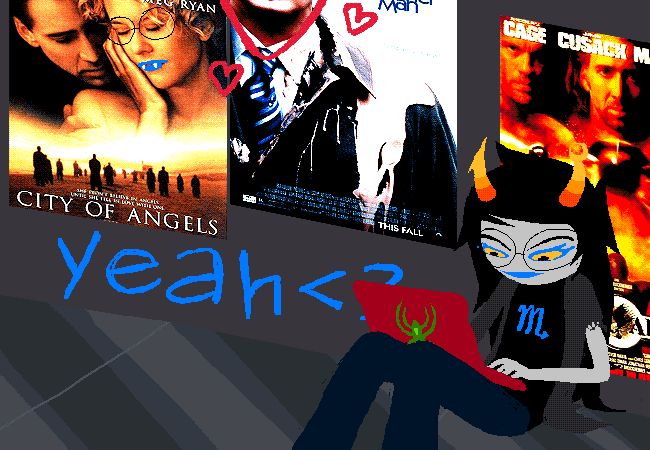
Have you ever gotten to the end of a really good book or movie and wished there was more to tell? You will never have that feeling with Homestuck.

Kuurion introduced me to Homestuck about the same time he wrote our original review for it. That was in June of 2012, and at the time I believed that I would have caught up with the story in about a month. At this point, having read literally thousands of pages and seen dozens of animations, I don't think I'll ever finish it. The story creator Andrew Hussie is telling moves too fast and has too many intricate parts for me to follow anymore. Half the purpose of this review is to apologize to Kuurion and let him know his favorite webcomic has bested me in fair combat.

Homestuck starts with a premise that is deceptively simple. Structured like a text-driven video game, Homestuck introduces you on its first page to an unnamed boy who has just had his thirteenth birthday, and suggests you name him. The reader doesn't actually have any control here, though; when the comic prompts you for something, it's almost like it's talking over your shoulder to someone you can't see. This gets the reader into the habit of ignoring the omnipresent second person structure - though, in appropriately surrealist fashion, it becomes important later. Or at least that's what I think happened.

The comic grows complex quickly, something that caught me off guard because the dialogue is so disarmingly simple. Our protagonist, now named John Egbert, lives a strangely insular life that seems to consist exclusively of talking with his friends Rose, Dave and Jade through an IM client. The story, while nominally a comic pretending to be a video game, is actually conducted largely through huge blocks of IM chat that appear as text beneath the picture part of the comic on most pages. Overshadowing this already complex set of proceedings is the fact that the apocalypse is about to start, and also John has just become the client player in a real-world video game called Sburb.

In fact, each of the four kids is either the server or client to another, allowing them to daisy-chain the control structure. The server player is actually more in control than the client, who appears on their screen - like a video game. What does the client player do? He or she fights imps, which have suddenly appeared and produce useful materials like "build grist" when defeated. The player can use grist and other materials to make things using a trio of confusing machines: the cruxtruder, the totem lathe, and the alchemiter. As the game's second person narration cheekily points out, you'll never have quite enough material to make the thing you want.

If you're not excited by this premise yet, then truthfully I've done something wrong. Homestuck is a masterpiece that will rope you in and hold you for a very, very long time. But it lost me and, try as I might, I can't get the magic back. Hussie shares Stephen King's gift for making the improbable a little too acceptable. The comic starts so far outside the realm of plausibility that it's actually managed to lap the readers by the time they've adjusted their expectations. In addition to the stories of the children, we're introduced to a number of side characters - starting with the Wayward Vagabond, an imp living in a desert in an unspecified time and place.

Once we've wrapped our heads around him, we're introduced to the trolls who are heckling the kids through IM. Except that they are literally trolls, who live on a planet in another universe and created our universe through a game of their own called Sgrub. Then we're introduced to a set of characters called the Midnight Crew in an "Intermission" segment that actually loops around the have direct bearing on the plot. Or maybe those two segments happen the other way around; for the purpose of this review, it doesn't really matter.

There's a pattern that repeats here: the stage keeps getting larger. We get to know the ground rules of the universe through John, and then we meet his three friends. Then we zoom out and meet the Wayward Vagabond, who becomes the first of several "wanderer" characters. Then we zoom out and meet the trolls who made John's universe. Then we go to a second universe, at which point the story breaks into two parallel lines and I gave up. Again, this is literally thousands of pages in, and still with no end in sight.

There are a lot of kind things that can be said about Homestuck, but since they've all already been said, I'd rather give voice to my own, slightly less kind thoughts. While I will openly and honestly say that Homestuck is a rare and significant cultural work, it's also susceptible to diminishing returns. I had loads more fun reading the story at the beginning before it become bogged down under accumulated internal mythology and story lines. There's just too much going on here, and I stopped reading because it stopped being fun to read.

Wednesday, July 31, 2013

Webcomic Review #9: Manly Guys Doing Manly Things

As I continue to stagger forward under a strange load of accumulated promises, I'm trying to keep work in rotation. That way, nothing stays undone for too long, even as I work towards getting everything operational again. To that end, here's a new Webcomic Wednesday. These things were supposed to be every Wednesday when they were new, I think, but I can't believe we were ever that ambitious. But hell, here's at least one for this month. Take it one piece at a time.

Fan fiction has always had a bad rap. I don't know why; I just know it has. However, the metric starts to change when there's a visual component. That's not to say DeviantArt gets an automatic "awesome" sticker from the Internet (even if it totally deserves it), but there's less of a bias. If I had to guess, I'd say it's because it's easier to digest something visually than through prose, but sometimes you meet somebody who takes the added bonus fan comics have over fan fiction and uses it as a step stool to greatness. And that brings us to to "Manly Guys Doing Manly Things."

MGDMT - conventiently located at thepunchlineismachismo.com for your browsing pleasure - is proof that a strange idea can unfold like a beautiful, weird flower as it matures. Those are the main characters in that comic above. Our protagonist is Commander Badass, a supersoldier for the future who has returned to modern day to run a temp agency for ultramanly men (usually from works of fiction). The woman next to him is Jones, romantic interest to him and exposition springboard for us. Since Manly Guys has its manly fingers in as many pies as writer Kelly Turnbull feels like, it wisely avoids examining what such an interconnected fanfic world would look like, and wisely sticks to a ground-level view. (One exception that still played to the rule showed the Commander eating breakfast cereal and watching members of the Lantern Corps rag on each other in the universe's version of C-SPAN.) In case you're wondering, this means Kelly actually saw "Green Lantern."

Helping the story bridge the gap between fan fiction and original work is Jared, the kid holding Fattest Pigeon. Jared is a Pokemon trainer whose favorite Pokemon is an extremely laconic Gyrados named Mr. Fish, who swallows Fattest Pigeon whole in the follow-up comic, prompting Jared to walk into its mouth for retrieval.

According to the site's 'About" section, "Jared is the end result of a complicated mathematical equation designed to compute the most completely average teenage boy ever," something I very much subscribe to. I had a friend who looked like this when I was in college, and you probably did to. Jared is a sort of intern for the commander, who never really knows what to make of him. Jared is similarly oblivious, and the two get on in good-natured confusion at all times.

Comics - which are usually stand-alone entries, but sometimes become arcs - showcase life at the apex of manliness. True to its offbeat form, this often leads to unexpected situations. In the very first comic, Kratos, from the God of War series, is shown trying to sell electronics through violence. In another, the commander makes Jared put money in a jar for using the word "epic." Sometimes wires get crossed and we see what it's like when a bunch of different fictional characters are played by one real-world actor:

From its springboard as a situational comedy into the most esoteric depths of fandom, "Manly Guys Doing Manly Things" is a rich tapestry of "What is this, I don't even." And if the Internet has yet to produce a higher form of art, I haven't seen it.

Sunday, June 23, 2013

The End of MythBusters

My wife has spent the last week out of town, staying with her mother, who had surgery on Monday. With so much time to myself, I've ended up watching a fair bit of "MythBusters," because we don't have real TV reception here and I tend to default to what I know on Netflix.

Netflix is a few years behind, so I've only actually seen one new episode, and that was only because it was one I'd somehow missed on my previous passes through. Of the episodes available, I've probably seen most of them half a dozen times. I've been watching "MythBusters" for years. But, as it enters its tenth year on the air, I find myself increasingly nervous about how, sooner or later, it will be cancelled, and take another of my lines to the past with it.

The show follows a fairly simple premise, but it's undergone a number of revisions as it's evolved. The first season introduced the setup: Two men, Adam Savage and Jamie Hyneman, "with over 30 years of special effects experience between them," tackle myths to see if they're possible or not. The net for "myths" has widened over the years: Originally the mix was mostly urban legends and historical tales, but as time went by an increasingly large number of things seen in movies came up.

Those earliest episodes seem downright primordial to someone who's kept up with the show. Adam and Jamie, somewhat uncertain before the camera, would introduce a myth and then test it. And then another. Then, usually, a third. Quick segments by Heather Joseph-Witham, credited as a "folklorist" on IMDb, would give context to the myths. She only did 18 episodes and, without being mean, I don't think anybody missed her. Interview segments seemed out of place as the series found its footing and became all about the explosions.

The very first episode I ever saw was "Explosive Decompression," the first episode of 2004 that was in reruns by the time I saw it in 2006 or so. This was classic "MythBusters": five episodes before the show's build team made its first proper on-camera appearance, and eight before Heather left. I don't remember her being in this episode, though; it was just Adam and Jamie.

By now the show had a good rhythm down. The very earliest episodes seem ponderous in retrospect: The guys would test one myth, then another, and yes, if there was time, a third. The introduction of the build team as a separate, autonomous group allowed the show to stagger the myths. Adam and Jamie would start a myth, then the build team would start a separate myth, then we'd go back to Adam and Jamie while they finished up, then the build team again, then Adam and Jamie would start something else, then the build team would finish, then Adam and Jame would finish their second myth as the credits rolled.

And, with a little more ironing to be done, that was the gist of it. The build team originally consisted of Tory Belleci, Scottie Chapman and Kari Byron. Scottie left the show in 2005 and was replaced with Grant Imahara. Like Scottie, he had a specialty - she did welding, he was into robotics. The others were more general-purpose, although Tory gradually built a well-earned reputation for hurting himself.

And that's how it is today, minus a period in 2009-2010 when Kari was off on maternity leave and was replaced with Jessi Combs. But a decade is a long time, and the popular consensus is that the show is beginning to flag. I remember having a discussion with a friend of mine, Eric, in 2010. He'd been my boss in college, and after I'd graduated I'd left the area to live out of state for six months. Coming back, he and I caught up on all sorts of things, including the show. We'd both been fans when I was in college, but he'd become disenchanted of late, calling them the "Fun Busters." He disliked how they took movie myths apart, feeling it ruined the fun of the movies.

When I got back was also when I lost track of the show. My mother - yes, I moved back in with my mother - didn't have full cable, and when my girlfriend and I moved in together, we didn't get it either. We didn't have the money. From the time I first saw the show before I left for college until the time I got back from Florida (where my rented room had cable), I kept up with the show. These were its best years, too - I'm currently rewatching the episode where they build and burn model Hindenburgs, but I remember when this episode was new in 2007. I also remember seeing a clip of it on the air years later, when narrator Robert Lee introduced it as a "classic episode." And that might have been the first time I felt a twinge of sadness, because I hadn't been aware of the passage of time before.

I'd comment now on how the hosts have aged, but the funny thing is that only Adam really has. Tory, Grant and Kari all look like they're in their late 20s to early 30s, but Kari is 39 and both the guys are 42. Jamie, born in 1956, looked 55 when the show started, and he looks 55 now. Adam, born in 1967, is the only one who seems to be aging normally. Over the show's run, his beard has grayed as his hairline has (unevenly) receded. It's possible they could push this another decade, but it seems incredibly unlikely. As the cast ages and the myth well depletes faster than it can be replenished, I see "MythBusters" hanging on for at least two more years but not more than five.

And it's going to break my heart when this happens, because "MythBusters" has always been there for me. I watched that very first episode in 2006 with the whole family gathered around the TV. Nobody does that anymore, not without also checking their phones and laptops while they watch. And there we were, and my brother looked at the hosts' vast shelving units full of improbably labeled bins and said to my father, who was to die 18 months later from a cancer we had yet to discover, "they have more crap than you do." My God, how we all laughed.

It was there for me in college, and I watched who knows how many episodes in my dorm room on a black-and-white TV I'd originally picked up as a gift for my then-girlfriend but grew too to love too much to give away. If I wanted to see an episode in color, I would go out to the dorms' common rooms and watch it there. I'd stay on campus during the summer to work at the print shop (with Eric, the friend I mentioned earlier), and I'd sit in the common rooms and watch "MythBusters" there while summer thunderstorms rolled in across the mountains. It was there when I joined DeviantArt in 2008, and has been the source for what is frankly the best body of fan art ever (sample above by Arashicat).

And it was there for me in Florida, a travel experiment that sucked. It's there for me now, even though I can't see the new episodes. Actually seeing the show is of secondary importance, believe it or not. It's enough for me to know that there are yet people in this world busting myths. I can catch up with the actual episodes later.

EDIT: Today, Adam Savage tweeted this:

I hope they live forever.

Sunday, June 9, 2013

Let's start again

Hello. I'm Captain Video. I like stories about zombies, explosions, hijinks, confusion, long odds, bad ideas, secrecy, honesty, deception, revenge, aliens, suburbia, explorers, sunken ruins, broken things, obsolete technology and doomed romance. And forgiveness. And redemption.

Sunday, March 17, 2013

Wednesday, March 6, 2013

Webcomic Wednesday #8: Dear Toadington

The original intent behind Webcomic Wednesday was, quite frankly, that we'd do them more often than we have. We haven't had one of these since the Homestuck review last June. The thing was, Kuurion got me into reading Homestuck at about that time, and I thought I'd be able to do my own review of it by July. It hasn't worked out that way because I still haven't finished Homestuck; it's incredibly complex and staggeringly long. So I just ended up not writing any more of these. Until now! Today is a Wednesday, and I'm making myself do this.

But I'm going to ease myself back into doing these with a softball review of a comic I love without reservation: Dear Toadington. It's made by two brothers, James and Jefferson Miller. The closest thing it has to a plot is shown in the first strip:

After that, each of the comics is titled "Stories About...", where each comic is a separate story being shared with Toadington. The whole setup is sort of like "Robot Chicken," except that I actually like Dear Toadington. I was made aware of it the one and only time they advertised with Our World as (and I'm paraphrasing from memory) "the webcomic for the discerning gentleman amphibian." At the time, this was the current comic. It's still one of my favorites:

It's smart and it's sick. I haven't liked, or even understood, every single Dear Toadington comic, but when I do, they're usually defined by those two characteristics.

It's rare for the people who pass through the warped lens of a DT strip to show up more than once, but there are exceptions. The Millers themselves appear in a number of comics (especially the early ones) and Daedalus, of mythological fame, appears in "Stories About History's Greatest Inventor," "More Stories About History's Greatest Inventor," and, as of this week, "Even More Stories About History's Greatest Inventor." His inaugural comic is a perfect demonstration of the Millers' sense of humor. Daedalus is tasked with building a labyrinth to contain the minotaur. The word "labyrinth" is normally used as a synonym for "maze," but in truth it isn't. A maze has dead ends in it; a true labyrinth is just a very long path. King Minos has his doubts when shown the blueprints, but Daedalus is sure that nothing could ever walk the whole two miles of the labyrinth and escape. Naturally, he is wrong.

The world of Dear Toadington is invariably childish but often hostile. In one comic, for instance, a man is shown walking down the sidewalk and is then randomly set upon by crows, with "CROWPOCALYPSE" written across the bottom of the page. In another, a different man walking down a different sidewalk arrives at a "sidewalk closed" sign, pops a Mentos in his mouth, and is shown in the last panel wearing a bomb vest in a standoff with police. In the series' most random cartoon to date, "Stories About Awkward Conversations," we see the Millers eating in a diner and discussing a Choose Your Own Adventure book when a sad looking clown comes up and puts a bloody handprint on the outside of the window. They both look at it, and then James asks Jeff again which adventure he chose.

Kuurion doesn't get Dear Toadington, something I have never faulted him for. Dear Toadington is not something that can be gotten 100% of the time. But, fortunately, they have a Twitter feed, which you might find useful for narrowing down why you aren't getting something in particular.

Wednesday, February 6, 2013

Don't Ask Me About the Plane

Salem, Massachusetts, is known for one thing, and one thing only: witch trials that were held there in 1692. Witch trials that, according to at least one TV documentary I saw, may have been fomented somewhat by the lack of any sort of entertainment in Salem. The natural irony is that all Salem entertainment today is based on witch trial history. Somebody needed to break this cycle. That somebody was the guy who runs this place:

This is a car repair place, although you'd be forgiven for thinking it was a mini golf. The guy who runs it also works at an animal reserve and rescue place in Cost Rica. Or something very close to that; he had a sign up inside that explained it properly, but I didn't have my camera with me then. This is his way of sharing with the world.